
Forest Spraying 3: Forest Fires
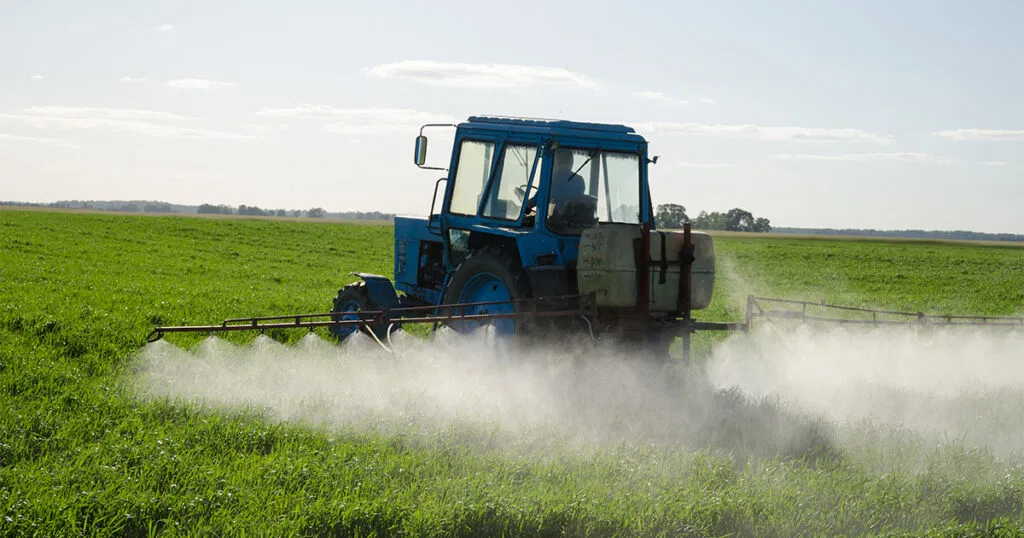
Glyphosate is the main pesticide being sprayed on Canadian forests, and it increases the risk of forest fires.
2023 Forest Fires
The 2023 forest fires in Canada were devastating and destructive. Almost 19 million hectares of forest were burned – markedly more than the previous average of 2.5 million hectares. Hundreds of fires exceeded 10,000 hectares and were considered ““megafires”. (NASA Earth Observatory) Some fires smoldered underground and are emerging as “zombies” fires.
Smoke emitted from the wildfires caused air quality alerts and evacuations in Canada and the United States. In late June, 2023, the smoke crossed the Atlantic, reaching Europe.
Contributing Factors
Climate change is considered a contributing factor. Warmer and drier weather makes vegetation more flammable, increasing the risk of fire.
The forest management practise of spraying with glyphosate is also a contributing factor, in at least two respects. First, spraying the forest with glyphosate- based herbicides dries down the forest even more. Second, …Read More

A Message of Hope, Light and Love
At this time of reflection and resolution, we offer you a message of Hope, Light and Love. We believe this trinity is quite powerful.
Powerful in the spiritual sense, as in “Hope springs eternal” “Light vanquishes darkness” “… and the greatest of these is Love”.
Also powerful strategically, when viewed in a certain way. Here is our thinking:
Consider Hope as goal-setting. A hope for world peace implies a goal “for something” .
Consider Light as the plan or the truth. It sets out the path for how to best get to the goal.
Consider Love as the power that fuels the work. It provides the energy to keep going.
This trinity works in achieving what you want. Take New Years’ resolutions: 1. set the resolution; 2. figure out how to get there; 3. keep at it.
At Safe Food Matters, we use the trinity in our work:
1. Our goals are safer …Read More

Safe Food Matters Goes Back to Court June 13 with Health Canada on Glyphosate
On June 13, 2023, Safe Food Matters returns to federal court in its ongoing battle with Health Canada over glyphosate, Canada’s most widely used herbicide.
This is the first step in our second lawsuit against Health Canada’s Pest Management Regulatory Agency (PMRA) for re-registering this harmful pesticide. We are seeking documents to show what’s really going on behind closed doors at the PMRA.
Why? Because something’s not right. In February, 2022, the Federal Court of Appeal ordered the PMRA to review our “Notice of Objection” for a second time – and the Court even provided “Guidance” to PMRA on how to address the issues. But PMRA did not follow the Guidance.
More than that, PMRA bent over backward to not address the concerns we raised. PMRA rewrote history. PMRA made up totally new legal tests. PMRA defied the rules of procedural fairness. It is clear PMRA does not want a review panel, even though the law allows for it.
So what’s going on?

SAFE FOOD MATTERS SUES AGAIN ON GLYPHOSATE
TORONTO – November 2, 2022 –
Safe Food Matters Inc. has launched its second lawsuit against Health Canada over its 2017 re-registration of glyphosate.
It claims Health Canada, through the Pest Management Regulatory Agency (PMRA), acted unreasonably and unfairly when on September 29, 2022 it rejected the group’s objections for the second time.
Safe Food Matters initially sued PMRA in 2019, lost in federal court, then appealed. The appeal was successful and on February 2, 2022, the Federal Court of Appeal directed PMRA to reconsider the objections, and to follow the Guidance of the Court when doing so.
The Court issued the Guidance to avoid the ‘endless merry-go-round of judicial reviews and subsequent re-determinatons. It aims to force PMRA to do its job and protect Canadians from the harms of pesticides.
Mary Lou McDonald, president of Safe Food Matters, commented:
“This is EXACTLY what the Court of Appeal didn’t want – PMRA is making …Read More
Glyphosate MRL Proposal Not Based on Sound Science
PMRA’s Proposal to increase glyphosate in legumes is not consistent with science or the law
Here’s an update to the glyphosate MRL story, the story of Health Canada’s Pest Management Regulatory Agency’s (PMRA) proposal to permit more glyphosate in foods. Safe Food Matters Inc. (SFM) and Prevent Cancer Now (PCN) received information on the “confidential test data” underlying PMRL 2021-10 (the Proposal). The data was received from PMRA on January 28, 2022, more than eight months after the date it was requested, May 12, 2021.
The groups report that the scientific and legal basis for the Proposal is ill-founded. This article provides a summary of the submission of SFM and PCN on the Proposal, which was provided to PMRA on April 13, 2022 (further to an extension granted to the two organizations). The full submission can be downloaded here.
The comments make various points. First, PMRA did not have jurisdiction to increase the glyphosate maximum …Read More
Safe Food Matters Wins Glyphosate Court Case!
Back to the drawing board for PMRA to address the glyphosate objection
February 2, 2022. The Federal Court of Appeal has issued a decision in favour of Safe Food Matters in a court case concerning the pesticide glyphosate. The decision remits the matter back to the Pest Management Regulatory Agency for reconsideration, and offers strong guidance to PMRA to avoid “the endless merry-go-round” of court applications and reconsiderations.
In 2017, Safe Food Matters (and others) filed objections to PMRA’s decision RVD2017-01 to re-register glyphosate in Canada, and PMRA rejected the objections in 2019 with a form letter and dismissive reasons. Safe Food Matters filed in Federal Court, lost, then appealed. The win means a review panel could still be struck to review RVD2017-01 and recommend that it be confirmed, reversed or varied.
When we started this case, we said ‘we believe in the law’, and our belief has come true. Legal activism …Read More

Lawsuit slams lack of transparency in Health Canada’s management of chlorpyrifos
PMRA sticks to three-year phaseout despite evidence chlorpyrifos causes brain damage in children
OTTAWA/TRADITIONAL, UNCEDED TERRITORY OF THE ALGONQUIN ANISHNAABEG PEOPLE —
Ecojustice, on behalf of Safe Food Matters and Prevent Cancer Now, is headed to court to fight for greater transparency, consistency, and accountability in how Health Canada’s Pest Management Regulatory Agency (PMRA) makes decisions regarding harmful chemicals that impact the health of Canadians.
In a lawsuit filed on Thursday, the groups challenge the PMRA’s Second Phaseout Decision regarding the dangerous pesticide chlorpyrifos. This decision maintains the three-year phaseout period set out in a previous decision from the PMRA, also being challenged by the groups in court. By maintaining the three-year phaseout, chlorpyrifos pest control products will continue to be used, including on food, until December 2023.
Health Canada first cancelled all uses of chlorpyrifos in May 2021 with a three-year phaseout, due to a failure of registrants to provide essential human health …Read More
Going to Court Over Glyphosate!
SAFE FOOD MATTERS Going to Court Over Roundup/Glyphosate
FOR IMMEDIATE RELEASE
TORONTO, February 12, 2019 – Safe Food Matters Inc. filed an application in federal court yesterday, challenging the re-registration of glyphosate, the active ingredient in Roundup herbicide. In 2017 it filed a notice of objection (“NoO”) to the re-registration decision and asked that an independent review panel be established. Eight NoOs were filed in mid-2017, and all were rejected on January 11, 2019.
“We have no choice but to go to Court on this issue” said Mary Lou McDonald, President of Safe Food Matters (and also a challenger in her own right). “We point out to the Pest Management Regulatory Agency (“PMRA”) exactly how this poison is concentrating in certain foods, and all they do is tweak the labels. The feds’ own data shows that label details aren’t followed or enforced. It is not right. They are completely ignoring the issue.”
In addition, …Read More

The Pickle of Labelling GM Salmon and Foods, and How to Avoid It
In May 2016, Health Canada approved a genetically modified animal (salmon) for human consumption.
This food is the first of its kind in the world. A federal committee that looked at the issue has provided its report, which effectively includes a recommendation to not label GM foods.
The Standing Committee on Agriculture and Ari-Food stated it supports mandatory labelling “only when a risk to health has been established …”, and that “no risks to health have been identified for GM foods approved in Canada”. (7,8)
But of course no health risks can be identified, because GM ingredients can’t be traced. Why not? Because they aren’t labelled. Bit of a Catch 22, eh?
The Pickle.
Canadians want labelling of GM foods. Health Canada in March, 2016 commissioned research to “obtain a more current reading on public opinion”. The findings (at 5) were that 78% of participants want GM foods clearly labelled on packaging, and that “consumers …Read More

SynBio, Gene Editing and Other New Stuff: Same Concerns, Supersized.
SynBio, Gene Editing, CRISPR…
New words like “synthetic biology,” “GMOs 2.0,” “CRISPR,” and “new biology” are being heard. And new compounds are in our fragrances, flavourings, cosmetics and foods.
The new words are for new techniques of genetic engineering. What are the techniques and their products, and should we be concerned?
New Techniques
The old techniques of genetic engineering (GMOs 1.0) dealt with organisms, and inserted genes by either blasting them into an organism or transferring them via a virus. This was not very precise.
1. Gene Editing. A new technique is called “gene editing”. It is more on target. It can cut the genetic code of organisms with greater precision, insert new code, remove a code and swap out genes with others. Tools used in gene editing include “CRISPR-Cas9”, “Zinc Finger Nucleus” and “TALEN”.
2. Synthetic Biology. Another new technique is the creation of genetic code from scratch, without involving living organisms. This is called “synthetic …Read More